

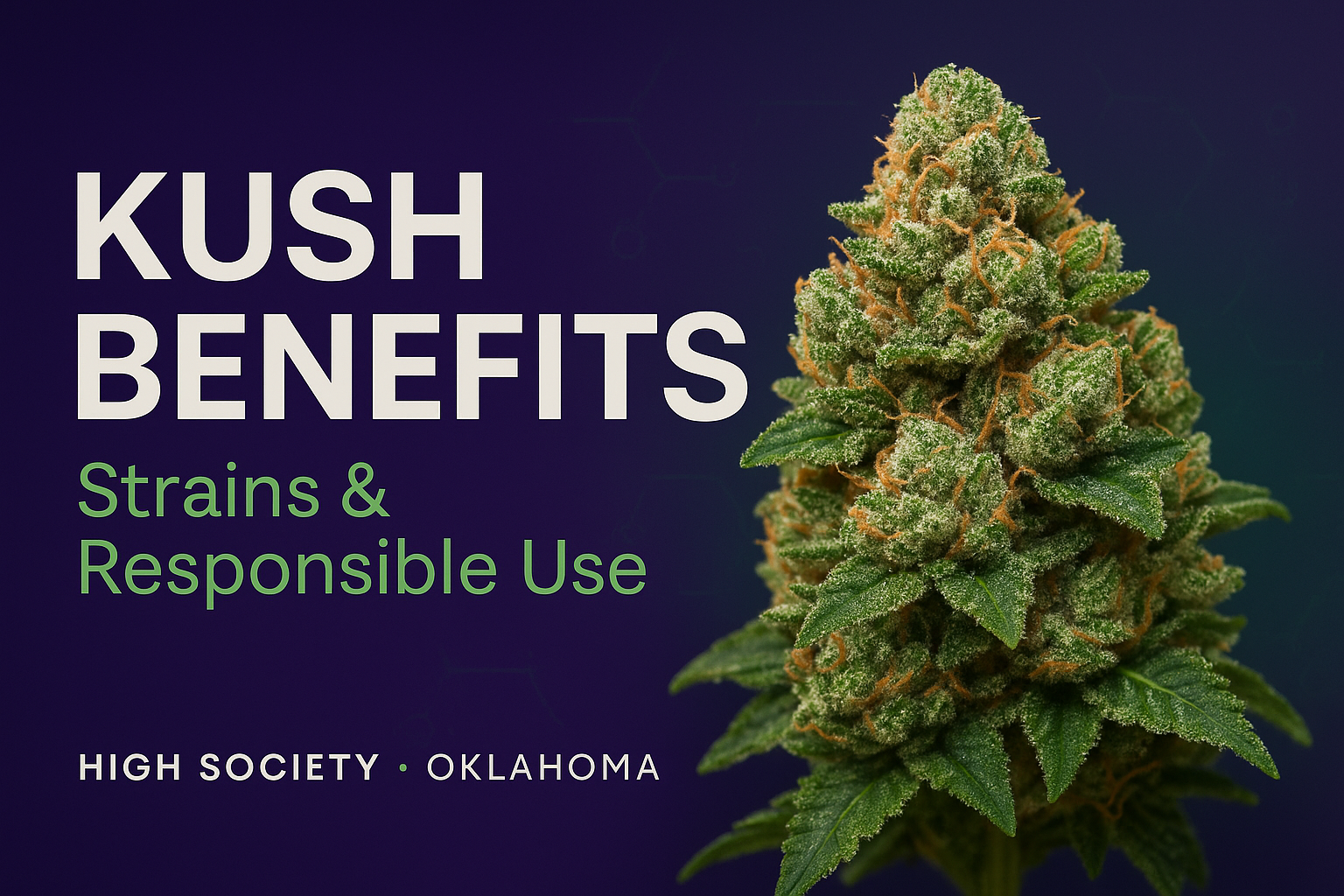
When people talk about “Kush benefits,” they are usually describing the way Kush-type cannabis strains feel for them in real life.
Most often, they are talking about indica or indica-dominant strains that they personally experience as heavier, more body-focused, or better suited to winding down.
Everyone’s experience is different, so “benefits” in this context is about individual preference and personal reactions, not guaranteed outcomes for anyone else.
Here at High Society, we use the phrase “Kush benefits” in a purely educational way.
Our goal is to help adult customers in Oklahoma understand what Kush strains are, how they are typically described, and how to approach them with intention and responsibility.
This article does not provide medical, legal, or dosing advice.
If you have questions about your health, medications, or whether cannabis is appropriate for you, those conversations belong with a licensed healthcare professional who understands your personal situation.
All content here is intended for adults 21+ and for registered OMMA cardholders in Oklahoma.
High Society operates as a locally owned, education-focused dispensary serving Oklahoma City and surrounding areas, offering a welcoming environment and knowledgeable staff at our different locations.
If you would like to visit one of our shops, you can explore all High Society locations in Oklahoma.
If you already know what you are looking for, you can browse our live menu and place an online order.
We do not claim that any product at High Society cures, treats, or prevents any disease or condition.
We also do not position cannabis as a replacement or alternative to traditional medical care or prescribed treatment.
Our role is to give you clear, accurate information so you can make informed, responsible choices within Oklahoma law.
What Is Kush? A Quick Guide for Oklahoma Consumers
The Origins of Kush Strains
“Kush” originally refers to cannabis plants that come from the Hindu Kush mountain region, a rugged area that stretches between Afghanistan and Pakistan.
Over many generations, these plants adapted to harsh, high-altitude conditions and became known for their hardy structure and thick, resinous buds.
These landrace plants inspired modern Kush lines that many Oklahoma consumers recognize today, including names like Hindu Kush, OG Kush, Bubba Kush, and Master Kush.
Across different breeders and brands, Kush-type strains tend to share a few common traits.
They are usually indica or indica-dominant, which means their genetic background leans more toward the indica side of the cannabis spectrum.
They often grow dense, chunky buds with a noticeable layer of sticky resin.
Aromas can range from earthy and piney to fuel-like or citrusy, depending on the specific genetics and terpene profile of each batch.
When you explore the menu at High Society, you will often see Kush strains labeled by name and type so you can easily spot them among other offerings.
Kush as a Family, Not a Single Strain
It is helpful to think of “Kush” as a broad family of cannabis genetics rather than one single strain.
Different growers may work with Hindu Kush, OG Kush, or other Kush parents and create their own crosses, each with a slightly different look, aroma, and effect profile.
Because most Kush strains are indica-dominant, many adults describe them as more “body-heavy” and better suited for winding down later in the day, but this is a general reputation, not a rule.
Two Kush strains can feel very different from one another, and two people can respond very differently to the exact same product.
There are several reasons why one Kush product may not feel like another.
Different breeders may use different parent strains and selection methods, even if the product names sound similar.
Cannabinoid profiles can vary, including changes in THC, CBD, and minor cannabinoids from batch to batch.
Terpene profiles can also differ, leading to distinct aroma and flavor notes and potentially distinct subjective experiences.
Cultivation techniques, drying, curing, and storage all influence how a Kush strain smells, tastes, and feels once it reaches the shelf.
At High Society, we list key details like strain type and lab-tested cannabinoid information so you can compare Kush options side by side before you decide what to try.
You can explore our current selection online anytime.
How Kush Compares to Other Strain Types
Kush strains sit alongside other major categories like sativa-leaning strains and balanced hybrids.
Sativa-leaning strains are often described by adults as more energizing or head-focused, although this can vary by person and product.
Balanced hybrids are bred from both indica and sativa backgrounds, and many consumers feel that these land somewhere in the middle of the spectrum.
By contrast, Kush strains usually lean toward the indica side and are often associated with more grounded, body-centered experiences.
It is important to remember that these labels are general guides, not guarantees.
No strain category can promise a specific sensation for every person.
Your own reaction to a Kush product may depend on your body, your tolerance, your environment, and how much you consume.
That is why many regulars at High Society prefer to pay attention not just to the word “Kush,” but also to the specific strain name, the listed THC and CBD levels, and the dominant terpenes on the label.
If you are curious how different categories feel for you personally, our team is happy to walk you through the menu and help you compare options in person at any of our locations.
The Science Behind Kush Experiences (Without the Jargon)
Cannabinoids 101 – THC, CBD, and More
When people talk about cannabis science, they usually start with cannabinoids.
Cannabinoids are natural compounds found in the cannabis plant that interact with the body’s own endocannabinoid system.
The two most well-known cannabinoids are THC and CBD.
THC (tetrahydrocannabinol) is the primary psychoactive compound in most cannabis strains, including many Kush varieties.
It is largely responsible for the feeling of being “high” or intoxicated that many people associate with cannabis.
CBD (cannabidiol) is non-intoxicating, meaning it does not create a classic “high” on its own.
Traditional Kush strains tend to be THC-dominant, which means they usually contain higher levels of THC and lower levels of CBD, although some modern Kush-inspired products are bred or formulated to feature more CBD.
In addition to THC and CBD, cannabis contains a range of minor cannabinoids such as CBG, CBN, and CBC.
These compounds are normally present in smaller amounts, and research is still ongoing to understand their individual and combined roles.
Scientists continue to study how different cannabinoid combinations correlate with different user experiences, but much of this work is still developing.
This article does not claim any specific medical outcomes or promise that particular cannabinoids will produce particular health results.
Any decisions about using cannabis in relation to your health should be made with a licensed healthcare professional.
If you are simply curious how different cannabinoid profiles feel for you, you can always compare product labels and ask our team at High Society to help you understand the numbers you see on our online menu.
Terpenes in Kush – Why It Smells and Feels the Way It Does
Beyond cannabinoids, Kush strains are known for their distinctive aromas and flavors.
Those scents and tastes come largely from compounds called terpenes.
Terpenes are aromatic molecules that appear in many plants, including herbs, fruits, and flowers.
In cannabis, they contribute to notes like citrus, pine, spice, fuel, sweetness, or earthiness.
Kush strains commonly feature terpenes such as myrcene, limonene, and β-caryophyllene.
Myrcene is often associated with earthy or musky aromas that many people connect with classic indica-leaning strains.
Limonene typically carries bright citrus notes that some consumers describe as lemon- or orange-like.
β-Caryophyllene can contribute peppery or spicy aromas that remind some people of black pepper or cloves.
Many Kush strains also include smaller amounts of other terpenes such as linalool, humulene, and pinene.
Linalool is frequently linked to floral, lavender-like scents.
Humulene can give a slightly herbal or woody aroma.
Pinene is commonly associated with a pine-forest smell.
A lot of adult consumers believe that terpene differences play a major role in how two Kush strains with similar THC levels can feel very different.
Some people informally describe certain terpene profiles as more “relaxing,” “uplifting,” “clear-headed,” or “heavy,” based on their own experiences.
From a science perspective, researchers are still exploring how specific terpene patterns interact with cannabinoids and how that might relate to subjective effects.
There is no universal terpene formula that guarantees a particular experience.
Instead, many cannabis enthusiasts use terpene information as one more data point to help them choose products that match their personal preferences.
To see terpene and cannabinoid information for current Kush offerings at High Society, you can check our live menu here.
The Endocannabinoid System in Simple Terms
The endocannabinoid system, often shortened to ECS, is a natural signaling system found in the human body.
It includes receptors, enzymes, and endocannabinoids (compounds produced by the body itself).
Two of the main receptor types in this system are known as CB1 and CB2.
CB1 receptors are found in many areas of the brain and central nervous system.
CB2 receptors are more commonly associated with immune cells and peripheral tissues.
Plant cannabinoids like THC and CBD can interact with these receptors in different ways.
THC can bind directly to CB1 receptors, which is one reason it can create noticeable changes in perception and sensation.
CBD interacts more indirectly with the ECS and other receptor systems.
Researchers are still actively studying exactly how the ECS works and how different cannabinoids influence it.
Most studies look at specific compounds or broad categories of cannabis rather than individual Kush strains or branded products.
Because the ECS is complex and every body is different, responses to the same cannabis product can vary widely from person to person.
This helps explain why two adults can consume the same amount of the same Kush strain and describe very different experiences afterward.
Understanding the basics of the ECS will not tell you exactly how you will feel, but it gives useful context for why cannabis effects can be so individualized.
If you are new to cannabis or returning after a break, it is wise to approach Kush strains gently, pay attention to how you feel, and avoid driving or operating machinery while under the influence.
The “Entourage Effect” and Kush
Another concept you may hear in conversations about Kush is the “entourage effect.”
The entourage effect is a theory that suggests cannabinoids, terpenes, and other plant compounds may work together in a way that shapes the overall experience of a given product.
Instead of looking at THC or CBD alone, this idea focuses on the full profile of the plant.
For example, a Kush strain with a particular mix of THC, CBD, myrcene, limonene, and β-caryophyllene might feel different from another strain with the same THC percentage but a very different terpene lineup.
Many Kush fans describe their favorite strains as offering a “layered” experience, and they often attribute this to the way cannabinoids and terpenes combine.
Some people say that certain terpene combinations seem to soften or sharpen the way THC feels for them, or that specific profiles feel more body-focused or more head-focused.
These are personal observations, not guarantees.
From a scientific standpoint, the entourage effect is still being explored, and there is no single agreed-upon formula that can predict how any one person will feel.
Real-world responses depend on your biology, your tolerance, the product you choose, and how much you consume.
The entourage effect is best treated as a helpful framework for thinking about Kush, not as a promise of specific results.
If you are curious, you can experiment within your comfort zone by trying different Kush strains, taking note of the cannabinoid and terpene information on the label, and seeing which combinations you personally enjoy.
Our team at High Society can help you compare products and understand the numbers you see on packaging and on our online menu.
If you would rather shop in person, you can find the High Society location that is most convenient for you.
As always, if you have questions about how cannabis might interact with your health, medications, or medical history, those questions are best answered by a licensed healthcare professional, not by a dispensary or an article online.
What People Commonly Associate with “Kush Benefits”
When adults talk about “Kush benefits,” they are usually describing how Kush-type strains feel for them, not making health or medical claims.
These conversations are based on individual experiences and preferences, and they can vary a lot from person to person.
At High Society, we treat these as reported experiences only and always encourage responsible, legal use for adults 21+ and OMMA cardholders.
Commonly Reported Reasons Adults Choose Kush Strains
Many adults say they reach for Kush strains when they want to unwind in the evening after a long day.
Some people describe Kush as providing a heavier, more “full-body” experience compared to certain other strain types.
Others choose Kush because they enjoy the classic flavor and aroma profiles, such as earthy, piney, gassy, or citrusy notes.
For a lot of cannabis fans, Kush strains are part of personal rituals like movie nights, creative downtime, gaming sessions, or solo relaxation at home.
These reasons are personal and subjective, and they are not guarantees of how any Kush strain will feel for you.
How Kush Is Often Described in Everyday Language
In everyday conversations, people often compare a “body high” to a “head high” when talking about Kush and other strains.
Kush is frequently mentioned on the “body high” side of that spectrum, though individual experiences can differ.
You may also hear people use phrases like “couch-lock” to describe feeling very relaxed and settled in one place.
Others talk about Kush as “calm but functional,” meaning they feel more grounded while still able to handle light tasks or conversations.
Some adults describe certain Kush strains as “smooth and mellow,” while others talk about them as “heavy and sedating.”
All of these terms are informal, subjective descriptions that people use to explain how a strain feels to them.
They are not technical ratings, and they do not predict or promise how a specific product will affect you.
The same Kush product can feel very different from one person to another, even at the same dose.
Your own reaction can depend on many factors, including how much you consume and your previous experience with cannabis.
Factors That Shape Each Person’s Experience
Tolerance and prior cannabis experience play a major role in how Kush feels for any given adult.
Someone who is new to cannabis may find a small amount of a Kush strain much stronger than a person with a higher tolerance.
The method of consumption also matters.
Flower and pre-rolls, vape cartridges, edibles, concentrates, and tinctures can all create different timelines and intensities of experience.
THC and CBD percentages contribute to how strong a product feels, but they are only part of the picture.
Terpene profiles and other plant compounds also vary from product to product and can influence how people describe the overall experience.
Mindset and environment make a difference as well.
Your mood, comfort level, and surroundings can shape how you perceive a Kush strain.
Whether other substances are involved, especially alcohol or other depressants, can significantly change how cannabis feels and may increase risks.
That is one reason responsible use guidelines suggest avoiding mixing Kush with alcohol or other intoxicating substances.
Research on Cannabis and Kush-Type Strains – What We Can (and Can’t) Say
Areas Scientists Are Actively Studying
Researchers around the world continue to study cannabis and its components in a wide range of areas.
Some of the topics that commonly appear in the scientific literature include pain, sleep, mood, appetite, inflammation, and neurological conditions.
These studies are usually focused on cannabinoids like THC and CBD, or on cannabis in general, rather than on specific brand-name or dispensary products.
Most research does not test individual Kush strains from particular growers, so it cannot speak directly to how any one Kush product at a dispensary will feel.
The evidence base is still evolving, and many results are mixed, preliminary, or limited to specific types of participants.
This means it is important to read cannabis research carefully and avoid jumping to conclusions about universal outcomes for all adults.
Nothing in this article should be taken as proof that Kush or any cannabis product will create particular health results.
Any questions about using cannabis in relation to your health or medical history should be directed to a licensed healthcare professional.
Why Evidence Doesn’t Equal a Personalized Recommendation
Even when a study finds a certain outcome for a group of people, that does not mean the same outcome will apply to you personally.
Research studies use specific dosages, product types, cannabinoid ratios, and consumption methods that may be very different from what you use in real life.
Participants in studies also have their own life circumstances, health profiles, and backgrounds that might not match yours.
Factors like age, genetics, metabolism, other medications, and overall lifestyle can all influence how one person responds compared to another.
Because of this, a research result is not the same thing as a personalized recommendation for an individual.
Dispensaries, including High Society, cannot diagnose, prescribe, or tell you that a specific product is right for your health needs.
We can explain what cannabinoids and terpenes are and help you read labels, but we cannot replace the guidance of a licensed medical professional.
Health Decisions Reminder:
If you are considering cannabis in connection with a health concern, always speak with a licensed healthcare professional who understands your medical history before making changes.
Setting Realistic Expectations About “Benefits”
When people talk about “Kush benefits,” they are usually sharing personal stories about how certain strains feel for them.
These might include comments about relaxation, creativity, flavor preferences, or how a particular Kush strain fits into their daily or nightly routine.
It is important to remember that no strain, including any Kush variety, can guarantee specific outcomes for everyone.
Any positive experience one person reports may not apply to someone else, even if they use the exact same product in the same way.
Individual biology, tolerance, mindset, and environment all play a role in shaping the experience.
The most responsible way to talk about Kush benefits is as potential experiences that people often describe, not as promises, prescriptions, or medical claims.
At High Society, our goal is to provide clear information about strain types, cannabinoids, and terpenes so adults can make informed choices within Oklahoma law.
Potential Drawbacks, Side Effects, and Safety Considerations
Short-Term Effects Adults Should Know About
Cannabis products, including Kush strains, can produce noticeable short-term effects, especially at higher doses or for people with lower tolerance.
Some of the possible experiences include intoxication, altered perception, and changes in coordination and reaction time.
These changes can make activities like driving, operating machinery, or performing safety-sensitive tasks dangerous and illegal while under the influence.
Kush and other THC-containing products can also be associated with dry mouth, red or irritated eyes, and an increased heart rate for some users.
Many adults notice temporary changes in memory, focus, and decision-making during a cannabis experience.
For some people, especially at higher doses, cannabis may bring on anxious, uneasy, or uncomfortable feelings rather than calm ones.
These reactions are not the same for everyone, but they are important to be aware of before consuming.
You should never drive, operate machinery, or engage in risky activities while under the influence of cannabis.
If you choose to use Kush products, plan ahead so you can consume in a safe place and allow yourself time to sober up fully.
Long-Term and Heavy-Use Considerations
Using cannabis frequently or in large amounts over long periods can lead to tolerance, meaning you may feel less from the same amount over time.
Some people respond to tolerance by consuming more, which can increase costs and the intensity of intoxication and side effects.
Heavy or prolonged use might affect mood, motivation, or daily functioning for certain individuals.
Research is ongoing into how long-term cannabis use may be associated with mental health, cognitive performance, and cardiovascular outcomes.
Findings are not the same for everyone, and many studies highlight the importance of dose, frequency, age of first use, and personal risk factors.
Many health authorities urge extra caution for heavier and earlier use, especially among people under age 25, due to ongoing brain development.
Because long-term patterns can be hard to spot in yourself, it can be helpful to check in regularly about your reasons for using cannabis and how it fits into your life.
If you have concerns about your usage, it is a good idea to speak with a licensed healthcare professional or a qualified counselor.
Who Should Be Extra Cautious or Avoid High-THC Kush
Certain groups of people are generally advised to be especially careful with high-THC products, which include many Kush strains.
Individuals under 21 and non-cardholding minors are not the intended audience for this content and should not consume cannabis.
Pregnant or breastfeeding people are often advised by health professionals to avoid cannabis due to potential risks to the developing child or infant.
People with a personal or family history of certain mental health conditions, such as psychosis, may be at higher risk of unwanted psychological effects from high-THC products.
Adults with serious heart or cardiovascular conditions may also need to be cautious, as cannabis can affect heart rate and blood pressure.
Anyone taking medications that may interact with cannabis should speak with a licensed medical professional before consuming.
If you fall into any of these categories or have other health concerns, it is especially important to consult a doctor before using Kush or any cannabis product.
High Society staff cannot provide medical clearance or tell you that cannabis is safe for your specific condition.
We can, however, help you understand product labels and direct you to explore our locations and menus if you and your healthcare provider decide that cannabis is appropriate for you.
Responsible Use Basics
A common guideline among many adult cannabis users is to “start low and go slow.”
This means beginning with a small amount, especially if you are new to Kush or trying a new product type, and giving it time to take effect before consuming more.
Avoid mixing Kush with alcohol or other depressants, as combining substances can intensify impairment and increase the chance of unwanted effects.
Use Kush products in a safe, comfortable environment where you can relax and do not have to drive or handle important responsibilities.
Store all cannabis products securely and out of reach of children, teens, and pets.
Original packaging and child-resistant containers can help prevent accidental ingestion.
Always know and follow local laws, including OMMA regulations and Oklahoma state rules for medical cannabis.
High Society operates within Oklahoma’s legal framework, and our staff will verify age and OMMA card status where required.
If you are unsure about rules or limits in your area, check official state resources and regulations for the most accurate information.
For adults who are ready to explore Kush products responsibly, you can start by browsing our online menu or visiting one of our locations.
Kush Products & Consumption Methods at High Society
Types of Kush Products You Might See on Our Menu
At High Society, our menu often includes a range of Kush-inspired options, depending on current inventory and seasonal availability.
Flower and Pre-Rolls are popular choices for adults who prefer traditional smoking or dry-herb vaporizing.
They typically offer a faster onset compared to many other formats, which makes it easier for some users to gauge how they are feeling in real time.
Vape Cartridges and Disposables provide a more discreet way to consume Kush-derived extracts.
They are convenient and often more concentrated, so it is especially important to use them mindfully and start with small puffs.
Edibles and Beverages Featuring Kush Lineages include items like gummies, chocolates, and drinks that are infused with cannabis oils or distillates from Kush genetics or similar profiles.
These options are known for slower onset and longer-lasting experiences compared to inhalation methods.
Concentrates such as wax, shatter, live resin, and other extracts made from Kush genetics are typically designed for experienced consumers who are familiar with high-potency products.
These formats can deliver very strong effects in a short time and should be approached with caution.
Topicals with Kush Terpene Profiles may include lotions, balms, and salves that are applied to the skin.
When used as directed, these products are generally non-intoxicating because they are not designed to enter the bloodstream in the same way inhaled or ingested products do.
Onset, Duration, and Intensity by Product Type
Different Kush product types can feel very different in terms of how quickly they start working, how long they last, and how intense they feel.
Inhalation methods, such as smoking flower or using a vape, usually have a faster onset.
Many adults notice initial effects within minutes of inhaling.
The duration for inhaled cannabis is often shorter compared to edibles, so some people find it easier to adjust their experience gradually.
Edibles, including gummies, chocolates, and drinks, generally have a slower onset.
It can take anywhere from 30 minutes to 2 hours or more for some people to feel the full effects, depending on factors like metabolism and whether they have eaten.
The experience from edibles can last significantly longer than inhalation, which is why careful dosing and patience are so important.
Tinctures can fall somewhere in between, depending on how they are used.
When placed under the tongue and held there briefly, some adults report faster onset than classic edibles, although swallowing quickly may shift the experience closer to an edible timeline.
Because of these differences, it is essential to wait an adequate amount of time before taking more, especially with edibles and higher-dose products.
Taking additional doses too soon can lead to stronger intoxication than intended.
If you have questions about timelines or how to interpret product labels, our staff can walk you through typical ranges and general guidelines, while still staying within compliance and not providing medical advice.
How We Help Customers Navigate Kush Choices (Without Giving Medical Advice)
High Society budtenders play an educational role in helping adults understand Kush products on the menu.
They can explain THC and CBD percentages, talk through terpene information, and help you compare one Kush strain to another in plain language.
Our staff may ask about the time of day you plan to consume, your past experience level, and the type of experience you are looking for, such as “chill,” “social,” “creative,” or “deep relaxation.”
This helps them point out product options that might fit your preferences, while still making it clear that everyone’s body responds differently.
Budtenders can also help you understand lab results and packaging details, including potency, batch information, and testing for contaminants.
What our team cannot do is diagnose medical conditions, recommend cannabis as a treatment, or tell you to stop or replace any prescribed medication.
We also cannot guarantee how a product will feel for you or how it will interact with your unique health profile.
Instead, we focus on giving you accurate product information and encouraging you to speak with a licensed healthcare professional about any health-related decisions.
Our goal is to support responsible, informed cannabis use for adults 21+ and OMMA cardholders in a friendly, community-focused environment.
Choosing a Kush Strain That Fits Your Preferences
Clarifying Your Goals Before You Shop
Before you add any Kush strain to your cart, it helps to get really clear about what you want from the experience.
Take a moment to think through a few simple questions.
First, when will you be consuming—daytime or evening.
Many adults reserve Kush strains for later in the day, while others prefer lighter options earlier on.
Next, ask yourself whether you are looking for something lighter and more functional, or deeper and more sedating.
Some Kush strains are described as more laid-back, while others are talked about as “knockout” level, depending on the person and the product.
Your sensitivity to THC is another key factor.
If you know you are sensitive or you are newer to cannabis, choosing lower THC percentages or gentler formulas can be a safer starting point.
Finally, think about which flavors and aromas you actually enjoy.
Kush strains often lean earthy, piney, gassy, or citrusy, so it is worth deciding whether you prefer something bright and zesty or richer and more fuel-like.
Going into the dispensary with these answers in mind can make browsing a lot easier, whether you are shopping online or visiting one of our Oklahoma locations.
Reading the Label Like a Pro
Once you know what you are looking for, the next step is learning how to read the label on a Kush product.
Two of the main numbers you will see are THC % and CBD %.
THC percentage gives you a basic idea of how potent the product may feel from a psychoactive standpoint, while CBD percentage tells you how much non-intoxicating cannabinoid is present.
Higher THC does not always equal a “better” experience, especially for people with lower tolerance.
Next, look for dominant terpenes, which are usually listed on lab results or product details.
Many consumers commonly associate certain terpenes with particular kinds of experiences, such as myrcene with heavier, body-focused sessions or limonene with brighter, more citrusy and mood-lifted descriptions.
These associations are based on reported experiences, not guarantees, but they can help you compare one Kush strain to another.
It is also useful to notice the grower or brand name, harvest date, and batch information.
Fresher products that have been stored properly are more likely to maintain their original aroma and flavor.
Knowing the grower or brand can also help you track which producers you tend to like.
Lab testing is a crucial part of the label story, especially in a regulated market like Oklahoma.
Testing helps ensure that products meet state standards for potency and for contaminants such as heavy metals, residual solvents, or microbial issues.
Kush Archetypes You Might Encounter
As you explore the High Society menu, you will probably notice that not all Kush strains feel or smell the same.
It can be helpful to think in terms of a few broad “archetypes,” based on how adults commonly describe them.
Classic “Heavy” Kush is often what people picture when they hear the word “Kush.”
These strains tend to have earthy, piney, or gassy aromas and are frequently described as strong and body-forward.
Many adults say they reach for this type of Kush when they want to really slow down and sink into the experience.
Balanced or Hybrid Kush sits somewhere in the middle.
These strains are often talked about as offering a mix of body relaxation and a bit of mood-brightening or mental ease, depending on the person.
They may feel more versatile for some adults who do not want to go fully into “couch mode.”
CBD-forward or “gentler” Kush options tend to feature lower THC and higher CBD compared to classic Kush strains.
Some adults prefer this style when they want a milder experience or when they are newer to cannabis and still learning how their body responds.
None of these archetypes are official categories, and they are not medical classifications.
They are simply ways people describe different Kush experiences in everyday language.
Tracking Your Own Kush Experience
Because Kush strains can feel different for everyone, one of the most useful tools you can use is a simple personal log.
This does not have to be complicated or time-consuming.
Start by jotting down the strain name and brand each time you try a new Kush product.
Include the THC and CBD percentages and, if available, the main terpenes listed on the label.
Note the product type—flower, pre-roll, vape, edible, concentrate, or tincture—and your best estimate of the dose you consumed.
Record the time of day and the setting.
Were you at home on the couch, hanging out with friends, or working on a creative project.
About 30–60 minutes into the session, write down how you feel in a few words or short phrases.
You can also add a note later in the evening or the next day about how long the experience seemed to last and how you felt afterward.
Over time, these notes can reveal patterns, such as which Kush strains you like best, which terpenes show up in your favorites, and which products feel too strong or not noticeable enough.
This kind of self-tracking is for personal insight only and is not a substitute for medical advice.
If you have health-related questions about cannabis, those are best discussed with a licensed healthcare professional.
Kush Benefits in a Compliance-First Framework
Why We Avoid Bold Health Claims
Cannabis is heavily regulated at both the state and federal levels, and that includes how dispensaries can talk about products.
Marketing rules are designed to prevent misleading claims and to protect consumers, especially when it comes to health and medical outcomes.
On top of state law, major platforms like search engines and social networks have their own rules about cannabis content.
These often restrict or prohibit claims that cannabis can treat, cure, or prevent specific conditions.
Because of this—and because it is the responsible thing to do—High Society does not make bold health claims about Kush or any other product.
We do not position cannabis as a replacement for conventional medical care or as an automatic solution to any health issue.
Instead, our focus is on facts, safety, and transparent product information.
We talk about what a product contains, how adults commonly describe their experiences, and how to use it responsibly within Oklahoma law.
This compliance-first approach helps us serve our community while respecting regulations and keeping our messaging honest and realistic.
If you are curious about specific Kush strains, you can always review detailed product information on our online menu or visit one of our locations.
How to Talk to Your Healthcare Provider About Kush
If you are thinking about how Kush or any cannabis product might fit into your life alongside your existing health routine, your best resource is a licensed healthcare provider.
They know your medical history, your current conditions, and the medications you may be taking.
Before you go to your appointment, it helps to bring a complete list of your medications and supplements, including over-the-counter products.
You can also write down what you are currently consuming in terms of cannabis—product types, rough amounts, and how often you use them.
Being open and honest gives your provider a clearer picture of what is going on.
During the conversation, you can ask about potential interactions or contraindications between cannabis and your current medications or conditions.
You can also ask what signs to watch for that might indicate cannabis is not a good fit for you.
It is important to emphasize that decisions about health conditions should be made with licensed clinicians, not with the internet, friends, or dispensary staff.
High Society can explain product labels, cannabinoid percentages, and general responsible-use principles, but we cannot diagnose or prescribe.
If you and your provider decide that cannabis fits into your plan, you can then explore specific products or at any of our Oklahoma locations.
Building a Thoughtful Cannabis Routine (If You Choose to Use)
If you decide to include Kush strains in your life, it can be helpful to think in terms of a broader routine rather than isolated sessions.
A thoughtful approach considers sleep habits, stress management, nutrition, and physical activity alongside any cannabis use.
For example, some adults choose to enjoy Kush only after they have finished responsibilities for the day, eaten a balanced meal, and set up a calm, comfortable environment.
Keeping usage intentional is a key part of this.
Try to avoid increasing your consumption out of boredom, stress, or habit without thinking it through.
Instead, ask yourself why you are reaching for a Kush product in that moment and whether it aligns with your original goals.
Periodic check-ins can be especially valuable.
Every few weeks, you might ask yourself whether your current cannabis routine is still serving you.
Questions like “Am I still using the amount I planned,” “Is this fitting well with my work, relationships, and responsibilities,” and “Do I feel good about how often I am consuming” can be helpful prompts.
If the answers raise concerns, it may be time to adjust your routine or talk with a healthcare professional.
Remember that cannabis is just one piece of a much larger lifestyle picture.
High Society’s role is to provide high-quality, clearly labeled products and friendly, educational support for adults 21+ and OMMA cardholders.
Kush, Oklahoma Law, and High Society’s Commitment to Compliance
High-Level Overview of Oklahoma’s Medical Cannabis Framework
Oklahoma has a state-regulated medical cannabis program overseen by the Oklahoma Medical Marijuana Authority (OMMA).
To purchase cannabis products from a licensed dispensary in Oklahoma, adults must hold a valid Oklahoma medical marijuana patient card or be otherwise authorized under state rules.
Regulations can change over time, so it is important to visit official state and OMMA resources for the most current legal information.
Nothing in this article should be taken as legal advice.
If you have questions about your eligibility or the rules that apply to you, checking official Oklahoma government and OMMA websites is the safest approach.
How High Society Stays Compliant and Community-Focused
High Society operates as a licensed dispensary and follows Oklahoma’s regulations for sourcing, testing, and selling cannabis products.
Products on our shelves are lab-tested according to state requirements, and we rely on those results for accurate potency and contaminant information.
Labels and menu listings are designed to clearly show THC, CBD, and other key details so customers can see what they are choosing.
We verify age and, when required, check valid OMMA cards before completing a purchase.
This helps ensure that cannabis products are only sold to adults who are legally authorized to buy them.
Our staff members receive training on responsible sales practices and on how to provide educational, non-medical guidance about strains, formats, and basic use considerations.
We focus on explaining product information rather than making medical promises or recommendations.
High Society is locally owned and involved in the Oklahoma City community, which means we care about how cannabis is presented and used in our neighborhoods.
Being both compliant and community-focused is central to how we run our stores and how we support our customers.
Finding Kush Products at High Society Locations
High Society has multiple dispensary locations in and around Oklahoma City, making it convenient for adults to explore Kush strains and other products.
Each store carries a rotating selection based on availability, including flower, pre-rolls, vapes, edibles, concentrates, and more.
You can see which Kush strains and Kush-inspired products are currently in stock by checking our online ordering platform.
The online menu allows you to filter by category, compare THC and CBD percentages, and view strain information before you visit.
If you prefer shopping in person, you can find the High Society location closest to you, along with hours and directions.
High Society also offers ongoing promotions and a loyalty program that includes deals on a variety of products, which may include Kush strains from time to time.
These offers are aimed at providing value for repeat customers while still promoting responsible, adult use.
Details about current specials can be found on our website or by asking a team member in-store.
FAQs About Kush Benefits, Effects, and Responsible Use
What makes Kush different from other cannabis strains?
“Kush” usually refers to strains that trace their lineage back to the Hindu Kush region and related genetics.
They are commonly indica-leaning and are often described as earthy, piney, gassy, or citrusy in aroma.
Many adults talk about Kush strains as more body-focused compared to some other categories, although that can vary by person and product.
Kush is not one single strain but a family of related genetics that can include many different crosses and breeder variations.
Is Kush always “stronger” or more sedating than other strains?
No, Kush is not automatically stronger or more sedating than all other strains.
Potency depends on the specific product’s THC and CBD percentages, as well as factors like dose, consumption method, and your own tolerance.
Some Kush strains are described as heavy and deeply relaxing, while others are talked about as more balanced or moderate.
Reading the label and starting with a low amount is a more reliable approach than assuming all Kush will feel the same way.
What do people usually mean when they talk about “Kush benefits”?
When people mention “Kush benefits,” they are usually sharing personal opinions about how Kush strains feel for them.
This might include comments about flavor, aroma, perceived body sensations, or how a strain fits into their routine.
These are reported experiences, not medical statements or guarantees.
High Society treats this kind of language as subjective and does not present it as proof of any health outcome.
Can beginners try Kush, or is it only for experienced consumers?
Beginners can choose Kush strains, but they may want to approach them carefully and start with lower THC levels or smaller amounts.
Because many Kush products are THC-dominant, they can feel intense for people with little or no prior experience.
First-time or newer consumers often find it helpful to talk with a budtender about potency, formats, and dosing basics before making a decision.
Our staff can provide that kind of education at any High Society location.
How do I know how much Kush is too much for me?
Everyone has a different tolerance, so there is no single amount that works for all adults.
A common guideline is to “start low and go slow,” beginning with a small amount and waiting to see how you feel before consuming more.
If you notice that your usage is regularly leading to uncomfortable experiences or interfering with daily responsibilities, that may be a sign to scale back.
You can also talk with a licensed healthcare professional if you have concerns about how much you are consuming or how often you are using cannabis.
What’s the difference between Kush flower, vapes, edibles, and concentrates?
Kush flower and pre-rolls are the dried plant material that can be smoked or vaporized and typically have a faster onset and shorter duration.
Vape cartridges and disposables contain concentrated cannabis oil and are inhaled through a device, often delivering stronger effects per puff than raw flower.
Edibles and beverages infused with Kush-derived oils or distillates are swallowed and usually take longer to kick in but can last longer once they do.
Concentrates such as wax, shatter, and live resin are highly potent extracts that are often used by more experienced consumers due to their strength.
Each format has different onset times and intensities, so understanding these differences helps you choose what fits your comfort level.
Is it safe to mix Kush with alcohol or other substances?
Mixing Kush with alcohol or other depressants can increase impairment and make it harder to predict how you will feel.
Many responsible-use guidelines recommend avoiding combining cannabis with alcohol or other intoxicants.
Doing so can raise the risk of unwanted effects such as dizziness, nausea, or feeling uncomfortably out of control.
If you have questions about how cannabis might interact with medications or other substances, you should speak with a licensed healthcare professional.
How can I learn more about specific Kush strains at High Society?
The easiest way to learn about specific Kush strains available at High Society is to browse our online menu at https://highsocietyok.com/order-online/.
Each product listing typically includes strain type, THC and CBD percentages, and other key details.
You can also visit any of our dispensary locations and speak with a budtender for in-person education about the Kush options on the shelf that day.
Location details, including addresses and hours, are available here.
Conclusion – Exploring Kush Responsibly with High Society
Kush is a broad family of indica-leaning cannabis strains known for their distinct genetics, aromas, and experience profiles.
Many adults describe Kush strains as more body-centered or grounding, but actual experiences vary widely from person to person and product to product.
In this guide, “Kush benefits” has been framed as the way people commonly talk about their experiences, not as guaranteed outcomes or medical claims.
Responsible use, good information, and awareness of your own body and limits are key to having a safer, more intentional relationship with cannabis.
High Society’s role is to provide compliant, clearly labeled products and friendly, education-forward support for adults in the Oklahoma City area.
We operate within Oklahoma law and focus on transparent product information rather than promises about health or medical effects.
If you are curious about how different Kush strains compare, you can explore our Kush-inspired options on the online menu here: https://highsocietyok.com/order-online/.
You are also welcome to visit your nearest High Society location to chat with a knowledgeable budtender about what is currently in stock.
For adults who shop with us regularly, signing up for our loyalty program is a simple way to stay updated on Kush drops, rotating specials, and other promotions.
However you choose to explore Kush, we encourage you to do so thoughtfully, within Oklahoma law, and in conversation with trusted professionals about your health when needed.
